Contact Us Today!

Solar Energy Services
1514 Jabez Run
Millersville, Maryland 21108

info@solarsaves.net

410.923.6090

Read More

Commercial Real Estate Energy Strategy in Practice

Commercial real estate energy strategy is how property owners gain control over long-term operating costs through on-site generation, efficiency upgrades, and infrastructure planning.

Across Maryland and the broader Mid-Atlantic, this is already happening at the project level. Owners are making practical decisions to stabilize expenses, improve asset performance, and reduce exposure to rising utility rates. These decisions are showing up in both retrofit projects and new construction.

How Energy Strategy Shows Up in Real Projects

On recent projects, energy is being addressed earlier in the planning process and tied more directly to financial performance.

Property owners are:

  • Locking in a portion of future energy costs
  • Reducing exposure to utility rate increases
  • Converting existing building surfaces into energy-producing assets
  • Improving predictability in underwriting

Energy is being evaluated alongside capital improvements and long-term asset planning, not treated as a separate line item.

What Energy Strategy Looks Like in Practice

Energy strategy is about controlling long-term operating costs and improving how a property performs over time.

In execution, that typically includes:

  • Integrating solar into planned roof replacements or new construction
  • Using available land or roof space for on-site generation
  • Aligning energy investments with capital improvement cycles
  • Designing systems that support long-term operational stability

From a financial standpoint, this creates more predictable expenses and supports stronger asset performance over time.

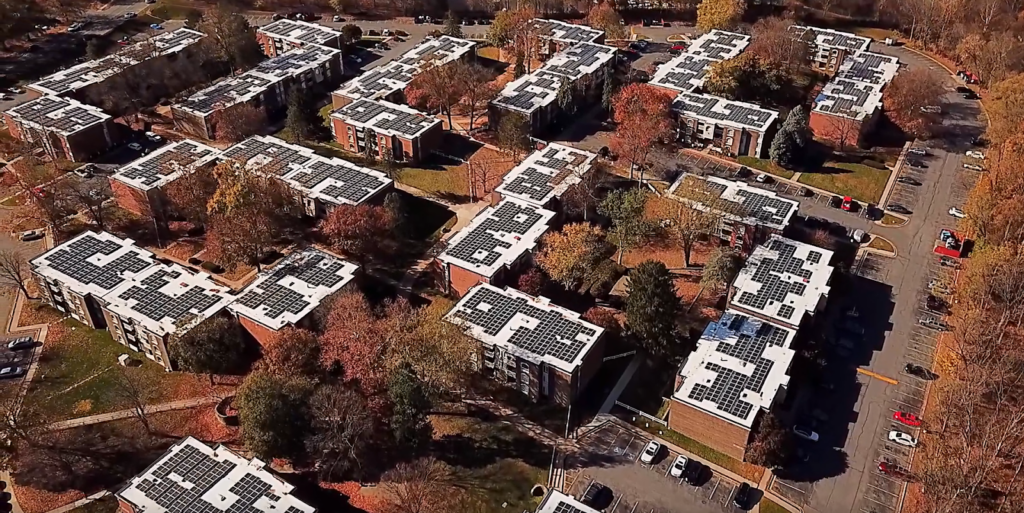
Case Study: Seneca Village
Project Overview

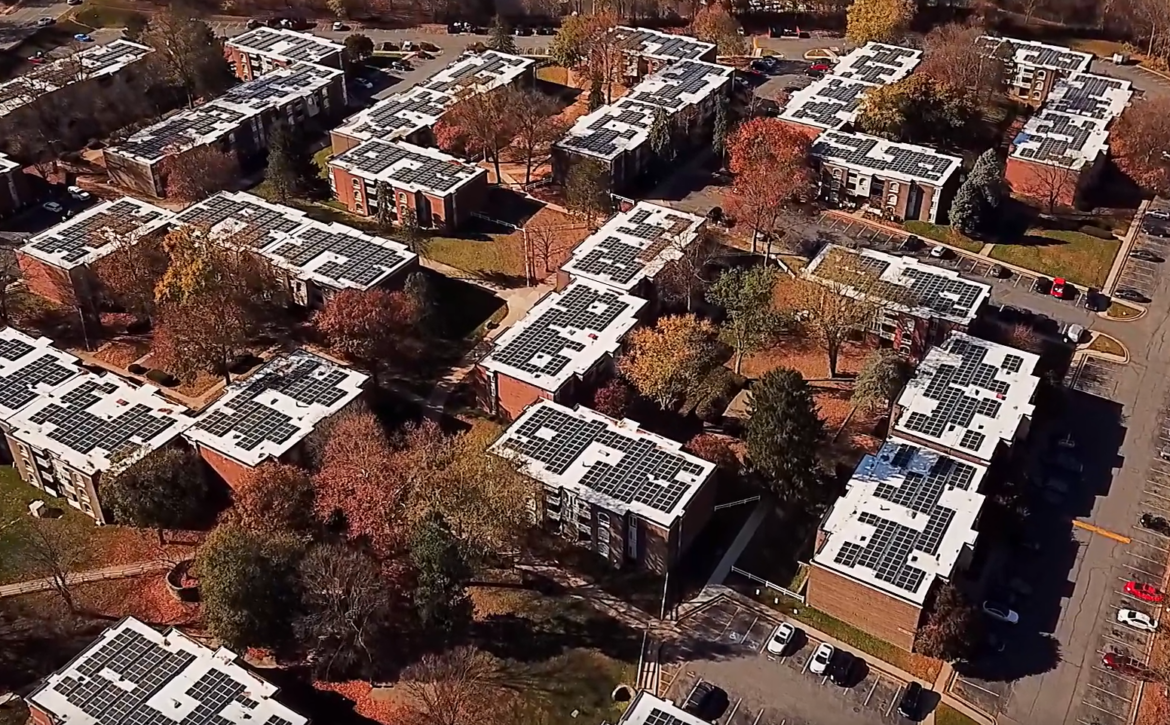
Maryland retrofit project featuring a 2.18 MW rooftop solar system

What Was Implemented

  • Reflective roofing system to improve building efficiency
  • Rooftop solar array for on-site energy generation

Owner Priorities

  • Reduce long-term operating expenses
  • Improve building efficiency
  • Increase overall asset performance

Execution

The roof replacement was coordinated with the solar installation to maximize system lifespan and avoid future rework. This alignment improved overall project efficiency and return on investment.

Outcome

  • Immediate reduction in energy costs through on-site generation
  • Improved building performance from reflective roofing
  • More predictable long-term operating expenses

This approach allowed the owner to upgrade an existing asset while addressing both cost and performance in a single project.

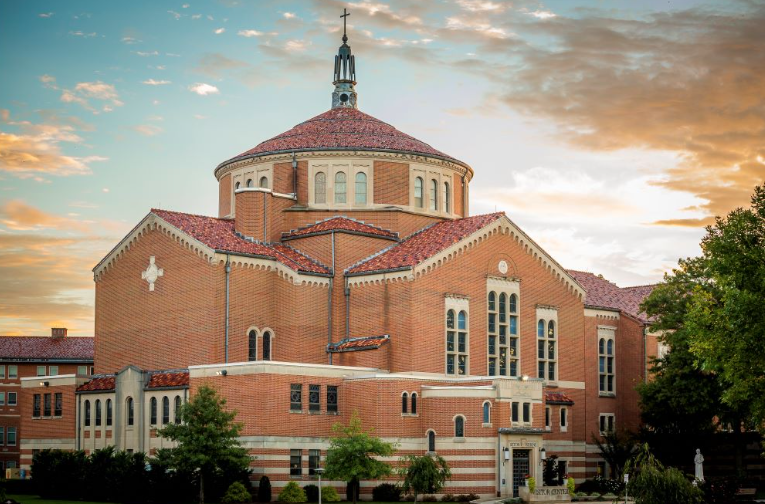
Case Study: National Shrine of Saint Elizabeth Ann Seton
Project Overview

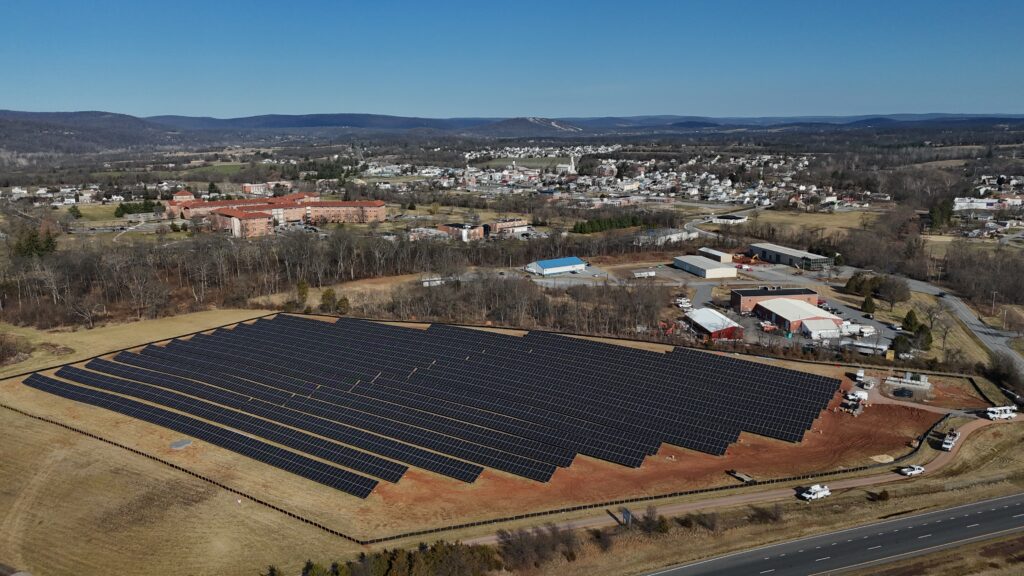
Emmitsburg, Maryland ground-mounted solar project, 2.65 MW system currently under construction in partnership with Mission Energy

What Was Implemented

  • Large-scale ground-mounted solar array
  • Use of available land for energy production

Owner Priorities

  • Offset a significant portion of energy demand
  • Create long-term cost stability
  • Invest in durable infrastructure

Photo by: Mission Energy Inc.

Execution

The project leverages available land to support a high-output system designed for long-term performance. System design focused on maximizing production to support campus-wide energy needs.

Outcome

  • Significant on-site energy generation supporting facility operations
  • Reduced reliance on grid-supplied electricity
  • Long-term cost stabilization for a large campus environment

For properties with available land, this model converts underutilized space into a high-value, energy-producing asset.

What’s Changing in Conversations With Property Owners

The shift is most noticeable in how conversations start.

Previously, discussions focused on:

  • What does solar cost?
  • What is the payback period?

Now, property owners are asking:

  • How do we stabilize operating costs?
  • How exposed are we to future utility increases?
  • Where can we create more control within this asset?

These questions lead to different project outcomes. Energy decisions are happening earlier and are more closely tied to financial strategy.

How Property Owners Are Using Solar Today

Property owners are typically using solar in three primary ways:

1. Cost Stabilization

Locking in a portion of energy costs to reduce exposure to rate increases.

2. Asset Optimization

Upgrading existing buildings to improve efficiency while generating energy, as seen in retrofit projects like Seneca Village.

3. Long-Term Infrastructure Planning

Designing systems that support ongoing operational needs, as demonstrated by large-scale projects like the National Shrine.

Each approach directly impacts both financial performance and day-to-day operations.

What This Means for Commercial Property Owners

For owners evaluating their portfolios, the opportunity is tied to existing assets and planned improvements.

A few starting points:

  • Which properties have the highest energy cost exposure?
  • Where can existing structures support solar installation?
  • How does energy factor into long-term financial planning?
  • Are there upcoming capital improvements that could align with energy upgrades?

Projects tend to perform best when energy strategy is aligned with planned upgrades, rather than treated as a standalone decision.

Commercial Solar in Maryland and the Mid-Atlantic

Across Maryland, Washington, DC, and Virginia, energy is becoming a consistent part of how commercial properties are evaluated and managed.

It is influencing:

  • Capital improvement planning
  • Asset repositioning strategies
  • Long-term operating cost management
  • Tenant expectations and competitiveness

This is already shaping how portfolios are planned and executed across the Mid-Atlantic.

Explore Energy Strategy for Your Portfolio

Solar Energy Services works with property owners, developers, and asset managers across Maryland, Washington, DC, and the Mid-Atlantic to identify where energy strategy can improve asset performance and cost predictability.

Start the conversation and see where this approach fits within your portfolio.
Read More

Inverters & Monitoring

When you’re ‘going solar’, one of the biggest technical choices you’ll make is between a string inverter and microinverters. That decision affects your system’s efficiency, cost, and long-term performance. The better option is entirely unique for each customer, it depends on your roof’s orientation, design, shading, etc. 

Monitoring — how you track your system’s production — comes bundled with whichever inverter type you choose. While some customers love ultra-detailed data from panel-level monitoring, for most homeowners, the simpler string-level monitoring is more than enough to ensure their system is performing well.

At SES, we’ve been maintaining solar systems longer than anyone in the region. Our service department supports all systems, whether we installed them or not, offering cleanings, inspections, diagnostics, repairs, replacements, and even remote monitoring. No matter which inverter you choose, we’re here to keep your solar system running at its best. 

Option 1: String Inverter (Example: Tesla Solar Inverter)

String inverters manage power from a “string” of connected solar panels. Most string inverters are designed to support several strings of panels. They provide system-level monitoring, a simple, cost-effective way to see how your solar investment is performing overall. The Tesla Solar Inverter, a common example of a high-quality string inverter, offers system-level monitoring.

Advantages:

  • More budget-friendly than microinverters.
  • Reliable, proven technology.
  • Easy to see your system’s total production.
  • Fewer system components.

Considerations:

  • No individual panel performance data.
  • One underperforming panel can slightly reduce the output of its string.
  • Tesla string inverters do not support automatic SREC reporting. Monthly readings must be submitted manually.

Best Fit: A great choice for homeowners who want reliable, cost-effective solar performance tracking, have simple roof layouts with minimal shading, and prefer an easy way to monitor their system’s overall production without diving into panel-by-panel details.

Option 2: Microinverters / Panel-Level Monitoring (Example: Enphase)

With microinverters, each panel operates independently and reports its own data. You can see exactly what each panel produces at any moment.

Advantages:

  • Pinpoint an underperforming panel instantly.
  • One panel’s issue won’t affect others.
  • Detailed, panel-by-panel performance tracking for those who love having deeper insights into their system.

Considerations:

  • Higher upfront cost.
  • More components to maintain.

Best Fit: Homeowners who want the deepest insights into their solar system’s performance, have roof layouts with shading or complexity, and value being able to quickly pinpoint and fix issues at the individual panel level. This option is also well suited for those willing to invest more upfront for enhanced monitoring and long-term optimization.

Choosing the Right Monitoring Option for You

Consider your specific needs and circumstances when deciding between string-level and panel-level monitoring. If you prioritize a cost-effective solution and have a relatively unshaded roof, string inverter monitoring will likely provide the essential information you need to ensure your system is operating correctly.

However, if you desire detailed insights into individual panel performance, have a complex roof layout with potential shading issues, or want the ability to pinpoint and address underperforming panels quickly, then panel-level monitoring is a valuable investment.

Your solar and storage consultant can help you assess your specific situation and recommend the monitoring solution that best aligns with your needs and budget.

Read More

Understanding Our Values: A Deep Look at Craftsmanship

At SES, our commitment to craftsmanship isn’t just a value – it’s in the center of just about everything we do. This core value shines brightly in all aspects of our work, perhaps most visibly in the field, as beautifully seen in the photos of our work.


The clean lines and meticulous execution seen in these images are a testament to the dedication and expertise of our field teams. But craftsmanship at SES extends far beyond what meets the eye on a project site. It is the meticulous attention to detail that is woven into every stage of our work: in our designs, in our customer communications, in our creative, and in all of our “behind the scenes”. While one person can have great craftsmanship, it is often and mostly delivered not just by one, but by a team.


Our project photos serve as a powerful example of this core value. The impressive work in the field is a direct result of careful planning, clear communication, and dedicated effort by everyone on the jobsite. It’s a reminder that craftsmanship isn’t just a skill, it is a mindset that permeates our entire organization.

We all take pride in the craftsmanship we bring to our work each and every day, in every role here at SES. It’s what sets SES apart and ensures we continue to deliver energy systems that are not only powerful but also are built to last.

Net Zero Electric for K&B True Value

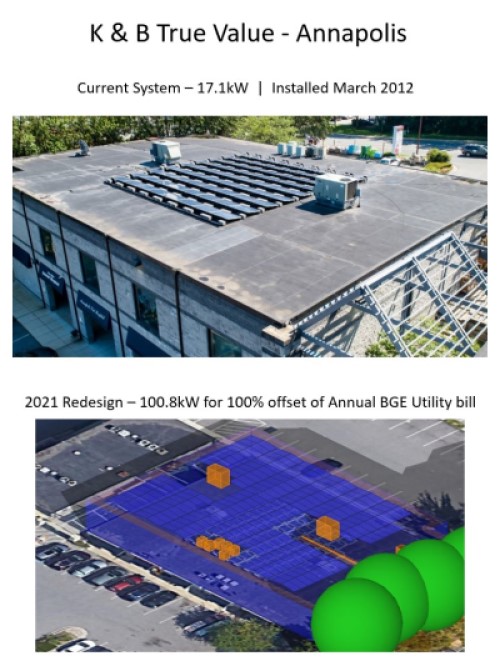
Jared Littmann was a real pioneer in 2012, when he made a substantial investment in a rooftop solar installation at his business, K&B True Value, to offset a chunk of the store’s electricity consumption. At that time, Solar Energy Services (SES) designed a 17 kilowatt (kW) solar project (72 panels in total) to offset about 15% of the store’s annual electricity consumption. With a projected payback of 5.5 years, this 2012 project was a good financial investment, but it was still a rare one. At the time, many commercial building owners were not interested in solar if it could not offset 100% of their energy. While 100% offset is ideal, it was certainly not a requirement for a good financial project. Jared understood that and to his credit went ahead with the investment. As promised, the system offset the projected energy and paid his business back in under 6 years.

solar panel install

Fast forward to 2021. K&B True Value’s solar system has been generating free energy for the business for years, but Jared wanted to do more. He reached out to SES and asked us to consider some options to increase his solar contribution. He had plenty of available roof space, so we looked at a supplemental system to the current one, but we also looked at a full new system to replace the 9-year-old system.

In a testament to the rapid decline in costs for solar, Jared was able to invest in an entirely new system to completely offset K&B True Value’s entire annual electricity consumption. That’s right – Net Zero on electricity! Have any other retail operations in Annapolis achieved this? We are not aware of any. Could other firms achieve this and benefit from the tremendous economics that will essentially provide free energy after the 7.5-year payback period? Yes, they can!

Solar energy costs have come down more than 75% since Jared’s first installation. That’s thanks to policy, competition, and scale. Now, many businesses and homeowners can achieve Net Zero electricity with relative ease, while making major improvements to the bottom line. Like Jared, businesses and homeowners can benefit from the state’s “netmetering” policy that allows excess solar energy to be fed back into the grid for credits to be used later. This allows the business owner to maximize the value of the solar investment without the need for batteries.

Some might wonder what happens to the energy that K&B True Value feeds back to the grid at times when the store is not consuming all the solar generation. Jared’s neighbors may not know it, but some of them are periodically using solar energy from Jared’s rooftop. The neighbors are paying the utility for that energy and Jared is getting a credit. And best of all, the line losses of transporting that energy are negligible since the solar energy is consumed by the nearest load. Typically, traditional electric energy incurs line losses anywhere from 10-15% when it travels from a wind or solar, coal or nuclear plant to the consumer. Rooftop solar gets consumed at or near the source of generation, reducing line losses and in many cases unloading the grid.

As this project develops, it’ll soon be time to remove the original panels from 2012. Jared is interested in donating them to a non-profit who will use them. If you know of any interested entities, please reach out to Jared at K&B True Value or Rick Peters at SES.

What’s next for Jared? He has visions of tying in electric vehicle charging and possibly battery backup in the future. Do you own your building and have some tax liability? If so, consider contacting SES for a free solar evaluation. Just ask Jared, you won’t regret it.

Editor’s note: K&B True Value is an Annapolis Green Founding One Hundred Supporter.

Solar Financing via Maryland’s Be Smart Loan Program

[vc_row][vc_column][vc_column_text]

Residential Solar ,Panels Solar ServiceSolar Energy Services, Inc. recently became an approved contractor with the Be SMART Home Loan Program. This State of Maryland financing vehicle offers unsecured loans of up to $30,000 at a 4.99% interest rate. Aimed towards Maryland residents looking to lower utility costs, improve energy efficiency and add value to their Maryland home. The following solar projects qualify:

Solar Electric (Photovoltaic) Systems

These grid-tied solar systems give homeowners the option of purchasing more than 25yr worth of electricity at a fraction of the cost of their “rented” utility rates. Systems are purchase outright, and are eligible for the multiple financial incentives currently available.

Solar Water Heating (Thermal)

These systems are entirely separate from solar electric (PV) systems. They are most cost-effective for a Maryland family of 4 or more who currently heats their home’s water with electric, propane or oil. They require a relatively small amount of roof space and the upfront investment is lower than solar electric.

What are the Loan Qualifications and requirements?

  • Maryland resident
  • Home Owner
  • Verification of income
  • Credit score over 640
  • Debt-to-income ratio below 50%
  • Completion of a home energy audit

There is up to $30,000 in financing available for eligible homeowners.

What other upgrades qualify for the Be Smart Loan program?

Other qualifying energy efficiency upgrades throughout the home could include: energy efficient roof replacement, geothermal system, air infiltration reduction measures, increased insulation, hot water system improvements, heating systems maintenance or replacement, programmable thermostats, ceiling fans, windows, doors, duct work and energy star appliance replacement.

Can any Contractor perform the work?

Contractors must be listed on the State of Maryland’s Approved Contractor List as found here: http://dhcd.maryland.gov/Residents/Documents/besmart/BeSMARTApprovedContractors.pdf

How do I Apply?

  1. 1. Schedule a solar site visit with Solar Energy Services, Inc.
  2. Submit the Be Smart Home Loan Application along with SES’s proposal of work to be performed
  3. Be SMART will processes your Home loan application. Approval is based on your proposal specifications, satisfactory credit and affordability
  4. Submit your Home Energy Audit from an Approved Contractor
  5. You receive Loan Approval along with the first of two project pay-outs
  6. Upon receipt of payment, your Be SMART Contractor, SES, moves forward with interconnection, permitting and subsequent solar panel installation.
  7. The final payment is provided by DHCD when the work is complete and a DHCD inspector confirms that the work meets specifications

MORE INFORMATION

CONTACT: BeSMART Home Loan Program

Community Development Administration

Maryland Department of Housing and Community Development

E: BeSmartHome.dhcd@maryland.gov​

P: 301-429-7402 ​​​​

Or

info@solarsaves.net

410-923-6090

[/vc_column_text][/vc_column][/vc_row]

Press Release: Ribbon Cutting for SES in Talbot County – Eastern Shore

[vc_row][vc_column][vc_column_text]

On Tuesday, February 21, the Talbot County Chamber of Commerce held a ribbon cutting for Solar Energy Service at Hot Desks, located at 7 Goldsborough Street in Easton.

Pictured above include Easton Town Councilman Pete Lesher, Talbot County Chamber of Commerce President/CEO & Easton Town Councilman Alan Silverstein, Bruce Strazza, Sarah Boynton (Midshore Riverkeeper Conservancy), Easton Town Councilman Ron Engle, Adam Shellhamer (BDK, Inc), Sabine Simonson (Talbot County Free Library), Kristin Lockerman (Avery Hall Benefit Solutions), Sue Waite (RAUCH inc.), Cynthia Jurrius (Mid-Shore Mediation),Dane Schriver (1880 Bank), Solar Energy Services Consultant John Marrah III, Dave Wooten (Office of Comptroller of MD), Adam Jones (Shore United Bank), Robin Marrah (Patriot Cruises), Rick Peters (Solar Energy Services), Bill Ewald (RAUCH inc.), Bill Bernard (Eating Easton/Eating St. Michaels), Rod Renner (Renner Management), Jameson Harrington (RAUCH inc.), John Marrah (Patriot Cruises) and Laura Heikes (Shore United Bank).

With over 35 years of solar experience, Solar Energy Services, Inc. (SES) is the regional leader for both residential and commercial solar systems.  We are a full service team providing solar design, installation and lifetime support to all our prospective and existing residential and commercial solar applications including Solar Power (PV), Solar Thermal (Water Heating) and Solar Pool Heating.

Maryland owned and operated SES is proud to announce its commitment to serving Talbot County and the Eastern Shore at large. A resident of St. Michaels, John A. Marrah III is your local resource to education on industry trends, product developments, and emerging technologies in the solar industry. John will advise the right solar installation for a particular project (Solar Power, Solar Thermal, Solar Pool Heating), and will work with the end user to calculate and design the most cost- effective and energy- efficient solar installation for your home or business.

SES’s leadership, administrative and installation teams live locally, hire locally and have deep ties to the regional solar industry as well the communities they serve.  410.226.6212

[/vc_column_text][/vc_column][/vc_row]

Press Release: Solar at the Chesapeake Bay Foundation

[vc_row][vc_column][vc_column_text]

Press Statement
6-15-15

Solar Service, Home Solar Panels, Chesapeake MDCBF Merrill Center to Install 106 kW Solar System

(ANNAPOLIS, MD) The Chesapeake Bay Foundation (CBF) and Solar Energy Services, Inc. (SES) announced an agreement today for SES to design and build a 106 kW, grid-tied solar photovoltaic system at the Philip Merrill Environmental Center, CBF’s headquarters.

The Merrill Center rooftop solar system will include more than 370 solar panels from US manufacturer SolarWorld, as well as inverter systems from Solar Edge. The panels will be installed primarily on the available roof tops, but the design also calls for some unique solar shade structures to provide additional benefits to the facility and its occupants.

SES president Rick Peters shared that SES is pleased to participate in this marquee project. “I know personally that CBF has led the way on sustainable initiatives in our region for a very long time. It is an honor to be selected to construct this project, which will help advance CBF’s message and their environmental stewardship.”

The solar system is projected to produce more than 133 MWh of electricity annually, enough to power more than 10 average Maryland homes. This will significantly offset the facility’s consumption of traditional electricity.

“While we have had solar panels at the Merrill Center in the past, we are adding this new capacity because it is now more affordable as well as more efficient,” said CBF Vice President Mary Tod Winchester. “The new array will generate enough electricity to provide one third of the power for heating, cooling, and other needs of the more than 100 staff who work here. As a non-profit, we will not benefit from the many tax incentives available, but we encourage other individuals and businesses to closely examine the costs and benefits of adding solar generation.”

The project is expected to be completed before the end of this summer.

About Solar Energy Services, Inc.

Solar Energy Services, Inc. (solarsaves.net) designs, builds and services solar power systems for institutional, commercial, and residential customers. The firm was founded by 37 year solar industry veteran Roger Perry who has longstanding ties to the communities served by SES. Based in Millersville Maryland, the 21 person firm operates in Maryland, DC, and Virginia.

About Chesapeake Bay Foundation

Founded in 1967, the Chesapeake Bay Foundation (www.cbf.org) is the largest independent conservation organization dedicated solely to saving the Bay. Serving as a watchdog, we fight for effective, science-based solutions to the pollution degrading the Chesapeake Bay and its rivers and streams. Our motto, “Save the Bay,” is a regional rallying cry for pollution reduction throughout the Chesapeake’s six-state, 64,000-square-mile watershed, which is home to more than 17 million people and 3,000 species of plants and animals.With offices in Maryland, Virginia, Pennsylvania and the District of Columbia and 15 field centers, CBF leads the way in restoring the Bay and its rivers and streams. Over the last four decades, we have created broad understanding of the Bay’s poor health, engaged public leaders in making commitments to restore the Chesapeake, and fought successfully to create a new approach to cleanup that features real accountability-the Chesapeake Clean Water Blueprint

[/vc_column_text][/vc_column][/vc_row]

SES Embraces SunPower Partnership

[vc_row][vc_column][vc_column_text]

Residential Solar PanelsMany of our prospective customers have been waiting to buy their panels in the hopes of significant advancement. “I want the technology to mature ” they say, “ and be state-of-the-art”. Well, the closest you can get to those standards with a production panel is with SunPower.

Ask around, do some Google searches. You’ll learn quickly that SunPower is considered the best with very little debate. In fact, it’s by far the best. This American born company launched out of the US university research system (the founder was a Stanford professor) has sustained a 23 year run to be acquired recently by a global energy company.

At Solar Energy Services we’re excited to report that we are now a SunPower certified dealer. We’ve always wanted to offer the very best PV product and now we can. SES is proud to tie our 35 year commitment to the industry to the world leader in solar panel manufacturing.

Many are aware that the cost efficiency of installed solar has improved dramatically in the last 5 years due to efficiencies gained through price competition, distribution improvements, development of installation techniques, and other process improvements. However, the physical efficiency of solar cells has advanced more slowly than most have hoped. The standard Chinese panel being installed by the majority of installers today (especially the large leasing firms) are in the 14-15% efficiency range. A few solar manufacturers have been able to stay notably ahead of the pack. SunPower remains out front with their standard 327 W panel (E20) at 20% efficieny. Sunpower’s new “X” (E21) is 21% efficient! That’s right, over 40% more efficient than the average panel out there. The X begins to ship in April 2013 – next month.

SunPower’s Maxeon cells are the industry leader in reliability and durability also. They’ve had only180 defects out of 7 million panels. That’s right, 1 in 39000! The Maxeon cell has redundancy in contacts, accommodating wear from thermal expansion. It has backside contacts that provide increases collection on the sunny side. They are highly durable with the best impact resistance ratings. They are backed by a solid company with great support and a bright future.

To recap, the physical efficiency of solar cells has been relatively stagnant, with the exception of a few leaders that have developed slow and steady progress. SunPower has led the way. The company has been around for over 23 years. They have the most durable solar cell in the industry and the highest performing. I must confess, the 3 year old solar PV system on my roof has panels made in China. If I were installing today, there is no doubt I’d choose SunPowerâ€Ķ

[/vc_column_text][/vc_column][/vc_row]

Environment Showcase at the Annapolis Film Festival 2013

[vc_row][vc_column][vc_column_text]Residential Solar, Panels Solar ServiceSave the Date: March 23rd, 9.30am at St. Johns College (Francis Scott Key Auditorium)

In February 2012, a few of us local, environmentally-minded companies got together and welcomed ex-CIA director James Woolsey, among others, to lead a panel discussion after the showing of Energy On Trial. The event was a great success

– just what you’d want from at this type of event – a few hundred local folks showed up, we watched a thought-provoking movie and either participated or bore witness to the controversial banter back and forth between panel members (nuclear vs other renewables).  As folks tumbled out into the lobby of the Auditorium they were met with some yummy treats and a few of us local, sustainable organizations and businesses ready to mobilize their renewed commitment to the environment.

This year, we’ve joined the larger platform of the Annapolis Film Festival and incorporated an Environmental Showcase at St. John Francis Scott Key Auditorium that features Robert Redford’s film “Watershed”, an environmental panel discussion as well as sustainable company/organization presence and refreshments.  Non-for-profits such as Chesapeake Bay Foundation and Annapolis Green will be alongside locally owned businesses such as Solar Energy Services, Inc. and Rain Barrels of Annapolis.

Download the Environment Focus flyer

Purchase tickets and passes here.

The Environment Showcase is part of the larger Annapolis Film Festival, March 21-24, 2013. In partnership with the City of Annapolis and the local Arts and Business Communities, the Annapolis Films festival aspires to bring a major new cultural event to our area.  90 films in four days will be showed at various sites around Annapolis involving guest speakers, filmmakers, parties, and much community involvement.  For more information contact The Annapolis Film Festival

[/vc_column_text][/vc_column][/vc_row]

Annapolis Restaurant Harry Browne’s Installs Solar Water Heater

[vc_row][vc_column][vc_column_text]

Commercial Solar Energy,Solar ServiceSlowly but surely the skyline on Annapolis’ State Circle is starting to change. First, the Governor’s Mansion in 2009 and just this month, the ever-popular Harry Browne’s Restaurant (http://www.harrybrownes.com) has joined the ranks of businesses jumping on the solar bandwagon. Not only an enthusiastic and self-professed carbon footprint reducer, Rusty Romo, Harry Browne’s owner since 1979, is a savvy businessman, “Although I have a vested interest in reducing my carbon footprint, there’s no question that the solid Return on Investment was the final straw in deciding to install a solar water heater.” This viewpoint extends throughout Rusty’s business dealings, particular with regards to his restaurant’s waste production. Prior to January of 2012, annual trash pick up was costing the restaurant around $13,000 per year. That cost has now been reduced to $4000 due to Rusty’s implementation of two recycling solutions: 1) Veterans Composting visits several times per week to pick up all of the restaurant’s food waste turning it into compost for farmers, gardeners and landscapers. 2) A Cardboard baler compresses all of the restaurant’s cardboard, hugely reducing the bulk for taking to a dumpster storage facility where it is pulled and weighed. Harry Browne’s averages at least two tons every twenty eight days. Depending on the market cost, cardboard reclamation pays him from $30 – $100 per ton. Restaurants have a large hot water load, and Harry Browne’s is no exception. The 250-seat restaurant easily consumes the 160 gallons of hot water per day provided by the solar water heating system installed by Millersville based Solar Energy Services, Inc. (solarsaves.net) The system includes two, 30-tube solar collectors, (approved by the Historic Commission), mounted on a flat roof in the back of the restaurant. These panels are joined, via a copper pipe run and pump control unit to two, 80g stone-lined water tanks in the basement. The solar system acts as a pre-heat to Harry Browne’s conventional gas system, offsetting around 50% of his annual hot water load.

ABOUT SOLAR WATER HEATERS and SES, Inc.

Solar water heaters are a time-tested, mature technology that are deployed every day by Solar Energy Services, Inc. (SES) of Millersville (solarsaves.net). In addition to restaurants, apartment buildings, universities, carwashes, detention centers and other government and institutional buildings continue to expand SES’s customer list. Roger Perry, a 35-year solar veteran and partner at Solar Energy Services, Inc., is still servicing solar water heating systems that he installed during the early eighties. Roger notes that “Given current financial incentives, solar water heaters are a no-brainer for any business in MD and DC that has a daily hot water load.”

[/vc_column_text][/vc_column][/vc_row]